
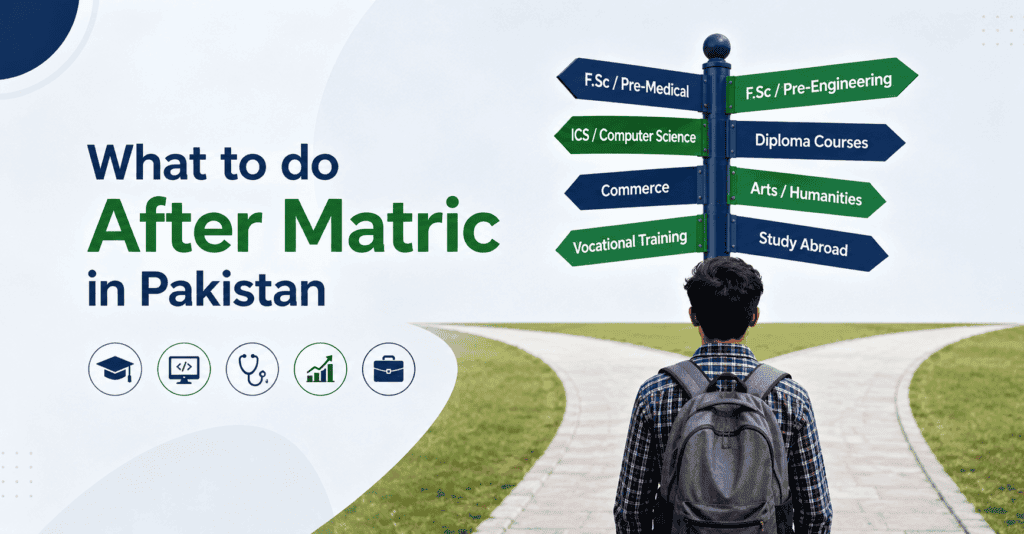
Matric result day is one of those moments that feels bigger than it actually is, and also smaller than everyone tells you it is. Relatives start asking about FSc or ICom before the marksheet has even printed properly. Neighbors compare percentages like it’s a competition. And somewhere in the middle of all that noise, the student is the one who actually has to decide what comes next. This post skips the generic career advice you’ve probably already heard and gets into the actual decision points that matter, group selection, alternate paths, and what each option really leads to a few years down the line.
Why This Decision Feels Bigger Than It Is
Here’s the thing most people don’t say out loud. The choice you make after matric in Pakistan matters, but it’s rarely the irreversible, life-defining moment it’s made out to be. Plenty of students switch from pre-engineering to commerce halfway through intermediate. Plenty of ICS students end up doing something completely unrelated to computer science five years later. The pressure around this decision is real, but it shouldn’t paralyze you into picking whatever your cousin picked, or whatever sounds most impressive at a family gathering.
That said, some choices do make certain paths easier and others harder. Picking pre-medical when you’re weak in Biology just because “doctor” sounds respectable tends to backfire. So does picking commerce without any real interest in it just because people say it’s easier. The goal here isn’t to scare you into overthinking this, it’s to help you pick something that actually fits.
The Main Groups You Can Choose After Matric
FSc Pre-Medical
This is the path toward MBBS, BDS, pharmacy, and other medical fields. It requires strong Biology, Chemistry, and Physics, and it’s genuinely one of the more demanding groups in terms of workload. If you enjoyed Biology in matric and don’t mind memorizing a large amount of material alongside understanding concepts, this fits. If Biology was something you tolerated rather than enjoyed, it’s worth being honest with yourself before committing two years to it.
FSc Pre-Engineering
This path leads toward engineering universities and requires strong Math and Physics, with Chemistry as the third subject. Students who liked solving numerical problems in matric Math tend to do better here than students who were memorizing formulas without fully understanding them. Pre-engineering also opens doors beyond just engineering, several other technical and analytical fields accept students from this background too.
ICS (Computer Science Group)
ICS combines Computer Science with Math and Physics, and it’s become a lot more popular over the last few years as demand for tech skills has grown. This group works well for students who are curious about how software and systems work, not just students who like the idea of a tech career because it sounds modern. If you’ve never actually tried any coding or logic-based problem solving, it’s worth testing that interest with a short online course before committing to two years of ICS.
ICom (Commerce Group)
ICom covers Accounting, Business Studies, and Economics, and it leads toward business, finance, and commerce-related degrees like BBA and BCom. This group works well for students who are more interested in how businesses and money actually work than in pure science or math. It’s a common misconception that commerce is the “easier” choice. It’s different, not necessarily easier, and doing well in Accounting specifically requires the same kind of consistent practice that Math does.
FA (Arts Group)
FA includes subjects like Islamic Studies, Civics, and sometimes Psychology or Fine Arts depending on the institution. It’s often underrated because it doesn’t get the same attention as FSc or ICS, but it’s a genuinely strong path for students interested in law, civil services, journalism, or humanities-related fields later on.
Beyond the Traditional Groups: Other Real Options
Diplomas and Vocational Training
Diploma programs in fields like electrical technology, IT, hospitality, or graphic design offer a faster, more skill-focused route compared to a full two-year intermediate program. These work particularly well for students who already know they want a specific technical skill rather than a broader academic path, and who want to start earning sooner rather than later.
Short Courses and Digital Skills
This is the option that’s grown the fastest in the last couple of years. Courses in web development, digital marketing, graphic design, and freelancing basics can be completed in months rather than years, and they lead directly into freelance work or entry-level jobs without waiting for a full degree. This doesn’t have to replace FSc or ICom, plenty of students do a short course alongside their intermediate studies as a backup skill or side income source.
O Levels to A Levels
If you’re coming from an O Level background, A Levels is the natural next step and roughly parallels FSc or ICS depending on subject choice. It’s a different system with different pacing, and it’s worth researching which local universities accept A Level equivalency smoothly before committing.
How to Actually Decide
Rather than starting with “what sounds impressive,” start with what you were genuinely good at and interested in during matric. Not what you scored highest in through memorization, but what you actually understood without struggling. A student who scored high in Chemistry through pure memorization but never really grasped the concepts is going to have a rough time in FSc, regardless of the marks on paper.
It also helps to think about workload honestly. FSc, especially pre-medical, involves a heavy amount of content. If you already know you struggle with long study hours, ICom or a diploma path might set you up for a less stressful two years while still leading somewhere solid.
Talk to people who are actually a year or two ahead of you in each path, not just relatives repeating general advice. Someone currently in FSc pre-medical can tell you honestly whether the workload matches what you expected. Someone in ICS can tell you whether the Computer Science content is what you imagined or something completely different.
What This Looks Like Practically at an Academy
Once you’ve picked a direction, the academy you join matters almost as much as the group itself. A good academy for FSc pre-medical needs genuinely strong Biology and Chemistry teachers, not just a general science department. A good ICS academy needs teachers who understand the Computer Science syllabus deeply, not just Math and Physics teachers stretched to cover a third subject.
CBS Academy teaches Mathematics, Physics, Chemistry, Biology, Computer Science, Accounting, Pakistan Studies, and Commerce, with subject specialists handling each one so students moving into FSc, ICS, or ICom get focused teaching rather than a generalist covering everything loosely. You can see the full subject breakdown on the subjects page, and current intermediate admission details are on the offerings page.
A Note on Combining Paths
One thing that doesn’t get mentioned enough is that these paths aren’t always mutually exclusive. A student in FSc pre-engineering can still pick up a short web development course over a summer break. A commerce student can learn basic digital marketing alongside ICom and have a head start on freelance income before even finishing intermediate. The traditional group you pick sets your academic direction, but it doesn’t have to be the only thing you’re building toward.
Frequently Asked Questions
What is the best option after matric in Pakistan? There’s no single best option. It depends on which subjects you genuinely understood well in matric and what kind of career direction interests you, medical, engineering, tech, business, or something else entirely.
Is ICS a good choice if I’ve never coded before? It can be, but it helps to try a short coding or logic-based course first to confirm the interest before committing two years to it.
Can I switch groups after starting intermediate? In many cases yes, though it depends on the college or academy’s policy and how far into the year you are. It’s easier to switch early than after several months.
Should I do a short course instead of FSc or ICom? Not necessarily instead of, but alongside can work well. A short course adds a practical skill while intermediate keeps the traditional academic path open.
How important is the academy I choose after matric? Quite important. The right group choice only helps if the teaching behind it is actually strong, especially for subjects like Biology, Chemistry, Physics, and Computer Science where conceptual gaps show up fast.
Final Thoughts
What to do after matric in Pakistan isn’t a question with one right answer, no matter how many relatives act like it is. FSc, ICS, ICom, FA, diplomas, and short courses each lead somewhere different, and the right one depends on what you were actually good at, not what looks best on paper for a few months. Take the decision seriously, but don’t let it turn into paralysis. For guidance on intermediate subject options and admissions, the contact page has everything you need to get started.


